Welcome to mszhe's blog
-
deno
- Deno官网:deno.land
- 安装
brew install deno (太慢,而且不是最新版本)curl -fsSL https://x.deno.js.cn/install.sh | sh (镜像安装)curl -fsSL https://x.deno.js.cn/install.sh | sh -s v1.1.0 (镜像安装 + 指定版本)
-
mysql docker 安装
sudo docker run -p 3306:3306 --name wp_mysql -v /root/data/mysql:/var/lib/mysql -e MYSQL_ROOT_PASSWORD=199529 -d mysql:8.0

ALTER USER 'root'@'%' IDENTIFIED WITH mysql_native_password BY '199529';

FLUSH PRIVILEGES;
-
FileChannel处理下载文件
- 示例
public static void main(String[] args) {
      String originFileUrl = "";
      String savePath = "";
      String fileName = "";
      InputStream is = null;
      FileOutputStream fos = null;
      try {
          URL url = new URL(originFileUrl);
          HttpURLConnection conn = (HttpURLConnection) url.openConnection();
          conn.setRequestProperty(USER_AGENT, USER_AGENT_VALUE);
          is = conn.getInputStream();

          //文件保存位置
          File saveDir = new File(savePath);
          if (!saveDir.exists()) {
              boolean mkdir = saveDir.mkdir();
              logger.info("mkdir : {}, result: {}", savePath, mkdir);
          }
          File file = new File(saveDir + File.separator + fileName);
          fos = new FileOutputStream(file);

          fos.getChannel().transferFrom(Channels.newChannel(is), 0, Integer.MAX_VALUE);

          fos.flush();
      } catch (Exception e) {
          e.printStackTrace();
      } finally {
          IOUtils.closeQuietly(fos);
          IOUtils.closeQuietly(is);
      }
  }
- 示例
-
ArrayList新增元素报UnsupportedOperationException错
- 代码
public static void main(String[] args) { List<String> list = Arrays.asList(new String[]{}); list.add("1"); list.add("2"); } - 报错
Exception in thread "main" java.lang.UnsupportedOperationException at java.util.AbstractList.add(AbstractList.java:148) at java.util.AbstractList.add(AbstractList.java:108) at com.yeting.tarot.service.UserService.main(UserService.java:193) -
原因
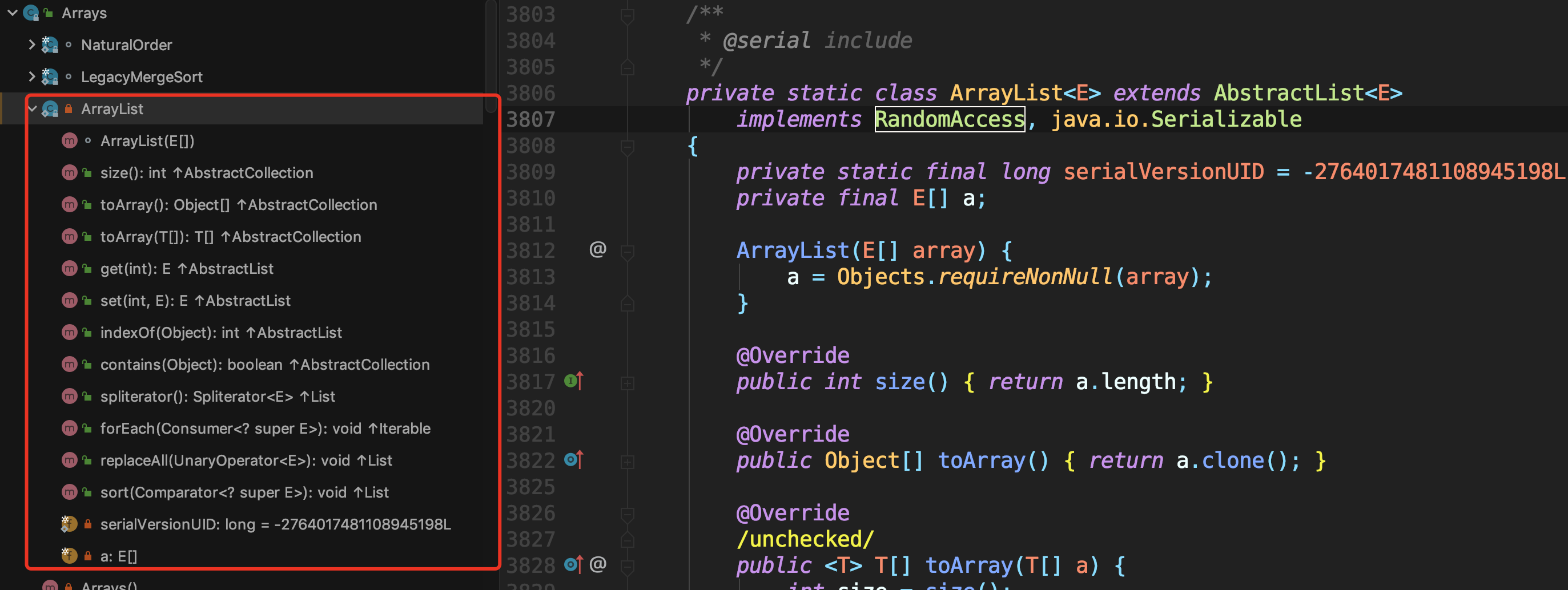
Arrays.asList内部ArrayList是内部单独继承实现的,没有实现add方法,跟java.util.ArrayList不是一回事,如图:
- 代码
-
响应式编程
2018-12-22mszhe什么是响应式编程
From Wikipedia
In computing, reactive programming is a declarative programming paradigm concerned with data streams and the propagation of change.- 关键字:
- declarative programming paradigm 声明式编程范式
- data streams 数据流
- propagation of change 变化的传播
- declarative programming 声明式编程
public static void declarative() { int[] iArr = {1, 2, 3, 4, 5, 6, 7, 8, 9, 0}; Arrays.stream(iArr).forEach(System.out::println); } - imperative programming 命令式编程
public static void imperative() {
  int[] iArr = {1, 2, 3, 4, 5, 6, 7, 8, 9, 0};
  for (int i = 0; i < iArr.length; i++) {
      System.out.println(iArr[i]);
  }
}
From Spring WebFlux framework
In plain terms reactive programming is about non-blocking applications that are asynchronous and event-driven and require a small number of threads to scale vertically (i.e. within the JVM) rather than horizontally (i.e. through clustering). A key aspect of reactive applications is the concept of backpressure which is a mechanism to ensure producers don’t overwhelm consumers. For example in a pipeline of reactive components extending from the database to the HTTP response when the HTTP connection is too slow the data repository can also slow down or stop completely until network capacity frees up. Reactive programming also leads to a major shift from imperative to declarative async composition of logic. It is comparable to writing blocking code vs using the CompletableFuture from Java 8 to compose follow-up actions via lambda expressions.- 关键字
- non-blocking applications 非阻塞程序
- asynchronous 异步
- event-driven 事件驱动
- scale vertically 水平扩展
- scale horizontally 垂直扩展
- backpressure 背压
- pipeline 管道
响应式编程框架
- 关键字:
-
syscall monitor
- 进程不能直接访问硬件设备,当进程需要访问硬件设备(比如读取磁盘文件,接收网络数据等等)时, 必须由用户态模式切换至内核态模式,通过系统调用访问硬件设备。
- strace可以跟踪到一个进程产生的系统调用,包括参数,返回值,执行消耗的时间。–linux平台
-
mac: dtruss(dtruss -p [PID])
- 用户空间:就是用户进程所在的内存区域
- 系统空间:就是操作系统占据的内存区域
Recent Posts
Categories
Tags